

Escape of water is one of the most common home insurance claims in the UK, and most of it starts small. A perished washer, a push-fit joint weeping behind the dishwasher, a pipe in the garage that freezes over a cold weekend. What decides how bad it gets is how quickly somebody notices.
That is why more homeowners are searching for a water leak detector in the UK. But there are two very different ways to build that protection. You can place floor sensors at the spots where you think a leak might happen. Or you can fit a whole house water leak detector on the mains water pipe, where it watches every drop that enters the home. Here is what each one does, what each misses, and how to choose.
What a floor sensor actually does
A floor sensor is a small puck you place on the floor. Typical spots are under the dishwasher, behind the washing machine, next to the hot water cylinder or boiler, and in the cupboard under the kitchen sink. It has two metal contacts on the underside. When water bridges those contacts, a circuit closes and the sensor sounds an alarm.
It is simple and it works. But be clear about what is happening. The sensor only detects water that has already reached the floor, and only at the exact spot where it sits. If the water runs the other way, it sees nothing. If the leak is in another room, it sees nothing.
And the warning comes late. The sensor beeps or sends a notification to your phone once the water is already out. The water keeps flowing until someone gets home and finds the stopcock. If you are at work, that is an hour. If you are on holiday, it could be a fortnight.
What a leak detector on the mains pipe does
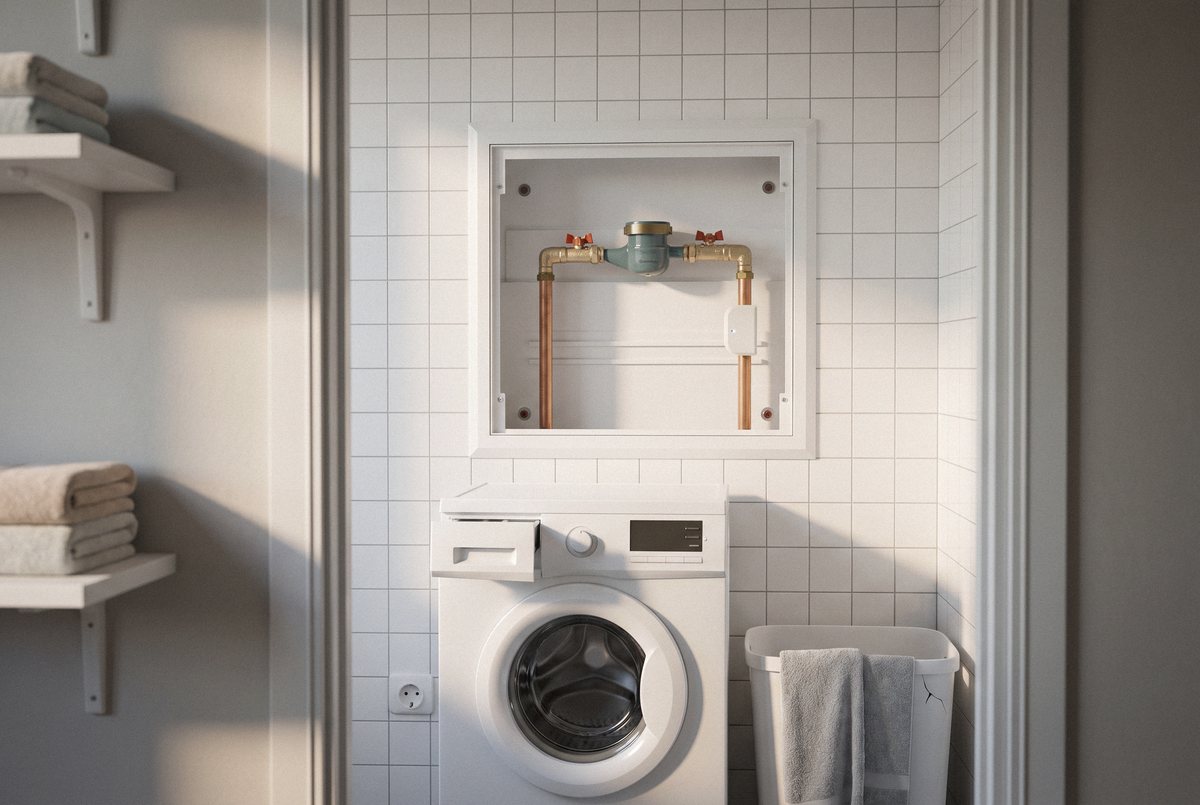
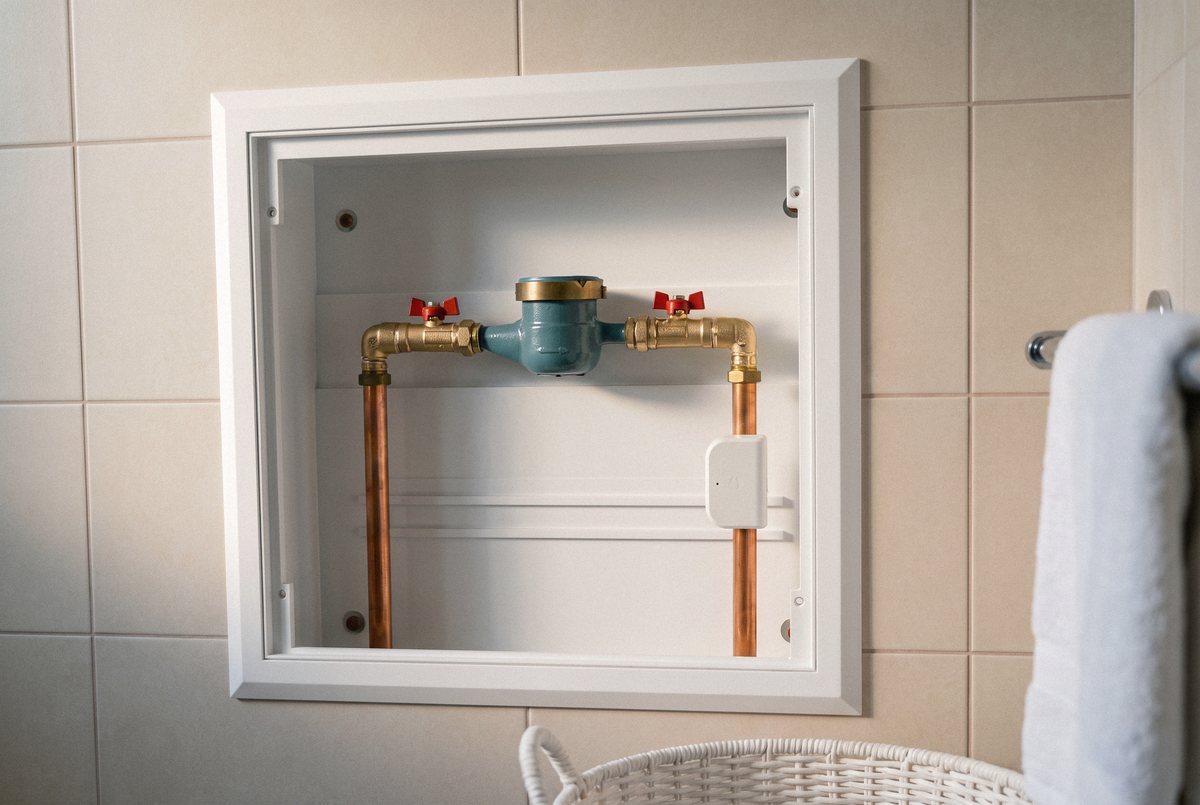
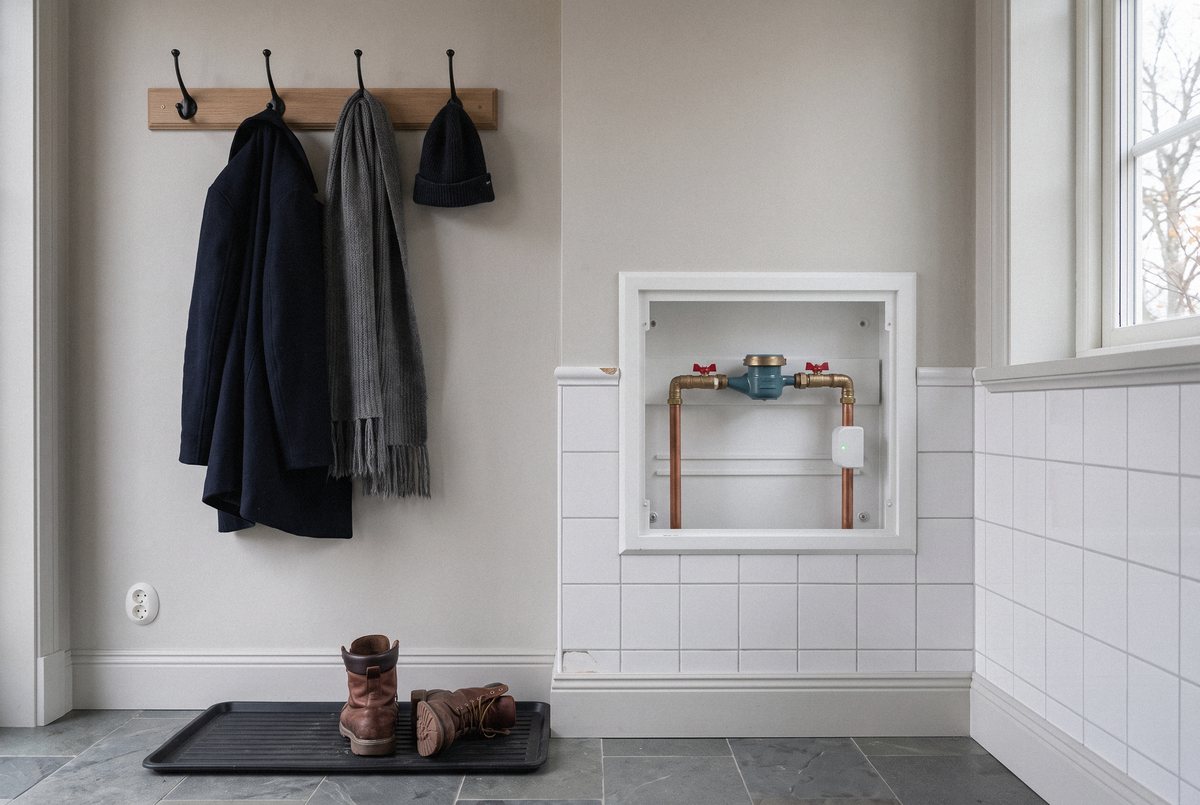
A whole house water leak detector works from a completely different place. It is fitted to the mains water pipe, the incoming pipe where water enters the home, usually near the stopcock. Every litre used anywhere in the house passes through that one point.
The device measures flow continuously. It sees the normal rhythm of the house: showers in the morning, the dishwasher in the evening, the washing machine at the weekend. And it reacts when something does not fit the pattern.
Some examples of what it picks up:
- A tap left running in an empty bathroom.
- A toilet that runs constantly because the fill valve has stuck.
- A small, steady flow in the middle of the night when nobody is using water. That is often the signature of a leak inside a wall or under a floor.
- A sudden large flow that does not stop, such as a burst pipe.
When it detects a leak, it sends an alarm to the app. A device like Water Grip alerts you as soon as the flow looks wrong, often long before any water reaches a floor. You can then turn off the stopcock or call a neighbour. That is the difference between a damp patch and a ripped-out kitchen.
The leaks floor sensors catch, and the ones they miss
Let us be fair. Floor sensors are good at one type of leak. If the dishwasher overflows and the water runs straight onto the sensor, it alarms quickly and clearly. The same goes for a washing machine hose that comes loose right above it.
But the list of what they miss is long:
- Leaks inside walls. The water runs down into the structure, not out onto the floor.
- Leaks under floors and between storeys.
- Leaks in any room without a sensor: the downstairs loo, the utility room, the outside tap.
- Pipes in crawl spaces, lofts and voids, often metres from the nearest sensor.
- A frozen pipe bursting in the garage or an unheated outbuilding.
- A running toilet. The water goes straight down the drain and never touches the floor, but the bill climbs and it can hide a bigger fault.
A monitor on the mains pipe sees all of these. It sees water moving when it should not be.
There is also one thing floor sensors can never do. A monitor on the incoming pipe can keep an eye on temperature. Water Grip has a freeze warning that alerts you when the temperature drops to 4 degrees Celsius, a function that went live in September 2026. That gives you time to act before the pipe freezes and splits. A floor sensor only finds out once the ice has thawed and the water is on the floor.
Batteries and upkeep: many sensors or one device
Here is the practical side people forget. For floor sensors to give reasonable cover, you need a lot of them. Kitchen, bathroom, utility room, downstairs loo. You are quickly at six to ten sensors.
Each one has a battery to change. Each one can drop off the network. Each one can get kicked aside when someone cleans or pulls the dishwasher out. It is easy for one to sit dead in a cupboard for six months without anyone noticing.
A whole house detector is one device in one place. You have one alarm to keep an eye on in the app instead of ten.
Comparison: floor sensors vs whole house leak detector
| Floor sensors | Whole house leak detector | |
|---|---|---|
| Where it sits | On the floor at each risk point | On the mains water pipe |
| What it sees | Water on the floor at that spot | All flow through the whole house |
| Leak in a wall or under a floor | No | Yes |
| Running toilet or tap | No | Yes |
| Frozen pipe | No | Freeze warning at 4 degrees |
| Alerts on the phone | Often, if Wi-Fi model | Yes, in the app |
| Number of devices | Many | One |
| Upkeep | Batteries in every sensor | One device |
Leaving the house empty: holidays and winter
The gap between the two is widest when nobody is home. A leak found after an hour is an annoyance. The same leak found after two weeks in Spain is an insurance claim, with floors lifted, mould behind the skirting and dehumidifiers running for months.
A floor sensor sends a notification, but only if the water reaches it. A whole house leak detector notices any flow in an empty house, where there should be none, and alerts you straight away wherever the leak is. Then you can ring a neighbour who has a key and knows where the stopcock is.
Winter is the same story. Holiday homes and houses with unheated garages or outbuildings are especially exposed. With a freeze warning you get a signal before something breaks, not after.
One tip whatever system you have: turn the stopcock off when you go away for a long stretch. It costs nothing and takes ten seconds.
Which should you choose?
Do you have an ageing dishwasher you do not trust and want a cheap extra check right there? A floor sensor earns its place.
Do you want protection that covers the whole house, including the parts you cannot see? Then a whole house water leak detector on the mains pipe is what actually protects you. It catches leaks in walls and floors, it spots the running toilet, and it sees all the water in the house, including rooms with no sensor.
Best of all is to combine them. The mains monitor as the base layer for the whole house. A few floor sensors as a top-up at the spots where you know an overflow can happen fast, like under the dishwasher.
The main thing is to have something. A leak does not wait for you to make up your mind.
Read next: A running toilet: the silent water waster and How to find a hidden water leak in your home.

Laisser un commentaire
Ce site est protégé par hCaptcha, et la Politique de confidentialité et les Conditions de service de hCaptcha s’appliquent.