

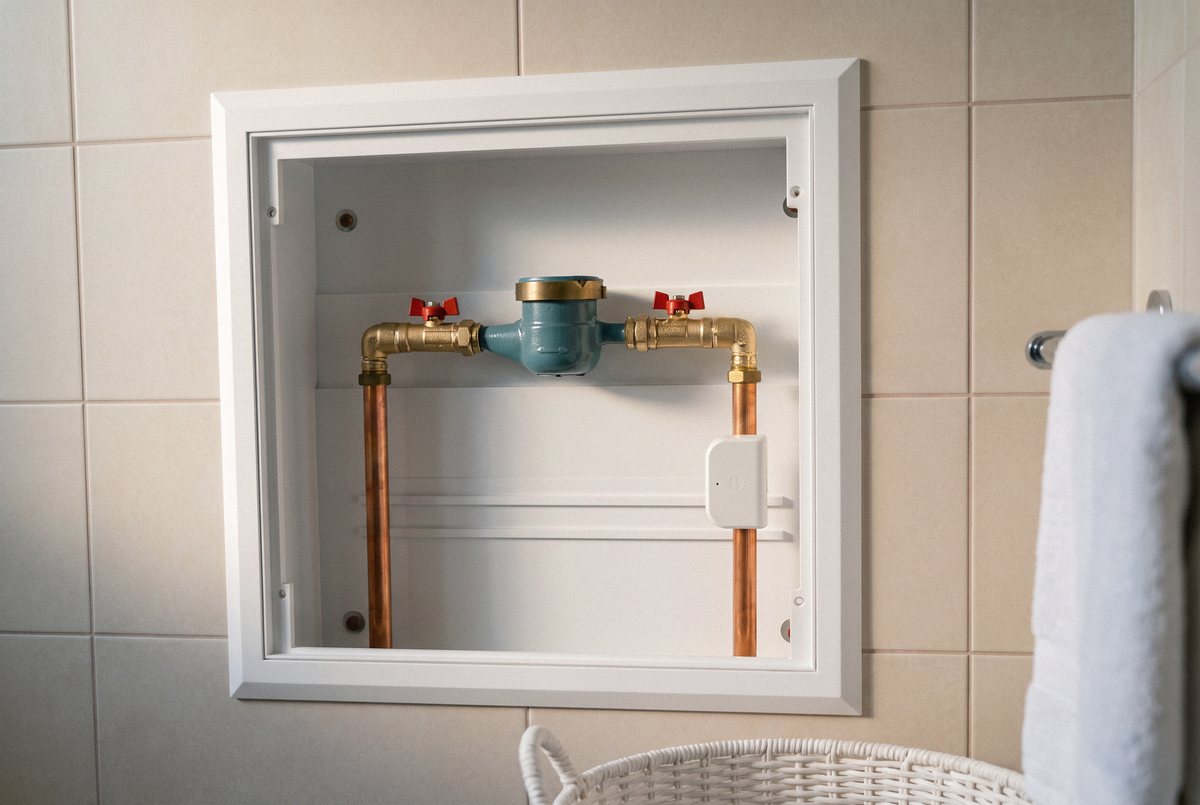
Most water damage does not start with a burst pipe. It starts with a hose behind the dishwasher weeping a little every day, or a fitting under the sink that drips for weeks before anyone notices. By the time there is a visible puddle, the water has been soaking into the floor and walls for weeks, and mould is not far behind.
So it makes sense to want some kind of protection. Water leak alarm vs automatic shut off valve, or something smarter again? This guide walks through the three main types, what each one actually does, and which kind of home each one suits.
The three types of leak protection
Broadly, there are three categories.
- Simple leak alarms, sometimes called point sensors. Small units you place on the floor where water might collect. When water reaches the sensor it beeps or sends a notification to your phone.
- Automatic water shut off valves. A motorised valve fitted to the mains water pipe, usually near the stopcock, that closes when it detects a fault. Normally installed by a plumber.
- Smart flow monitors: measure, recognise and alert. Also fitted to the mains pipe. They measure flow continuously, recognise unusual patterns and alert you in an app, but do not shut off the water. Often described as a whole house leak detector.
Each solves a different problem. We take them one at a time.
Simple leak alarms: cheap and quick to set up
A simple leak alarm is the easiest place to start. You buy a few, put one under the sink, one behind the washing machine and one next to the boiler or hot water cylinder. Done.
Many models connect to your Wi-Fi so the alert reaches your phone wherever you are. The strength is the price and the simplicity. The weakness is that the alarm only reacts once water is already on the floor, and only where the sensor happens to be. A leak inside a wall, under a floor or in the loft goes unnoticed. And the alarm does not switch anything off. If nobody is home, the water keeps running until someone gets back and turns the stopcock.
They work well as a complement to something else, or for a flat where you only want to watch a few vulnerable spots.
Automatic shut off valves: they actually stop the water
An automatic water shut off valve sits on the mains water pipe, the point where water enters the home. It closes the supply when it detects abnormal flow, such as water running continuously for an unusually long time. Some models can also be linked to point sensors that trigger the valve when they get wet.
The big advantage is that it does something when things go wrong. The water is cut off whether you are home or not. This is why insurers often mention them, and some may recommend or ask for one on certain types of property. What applies to you depends entirely on your policy, so check with your insurer.
The downside is that many of the simpler valves are quite basic in their logic. They see flow or no flow and tell you very little else. Installation on the mains pipe is normally a plumber's job, so the upfront cost is higher than a handful of sensors.
If you are searching for the automatic water shut off valve UK homes typically fit, this is the category: a house with its own mains supply, and especially one that stands empty for part of the year.
Smart flow monitors: measure, recognise and alert
A smart flow monitor also sits on the incoming mains pipe, but instead of closing a valve it watches the water and tells you what is going on.
It measures flow all the time and can learn your household's normal use. A shower has one profile, a dishwasher another. When something does not fit, such as a small but constant flow at three in the morning, it sends an alert to the app, wherever you are. It does not shut off the water itself. You, or someone you call, turns off the stopcock.
Water Grip is one example of this type. It clamps onto the incoming water pipe, measures flow continuously, recognises abnormal flow and sends an alarm to the app when it detects a leak. Anyone can fit it in a few minutes. Since September 2026 it also has a freeze warning at 4 degrees Celsius, useful in holiday homes and cold spaces such as garages.
So which is better? A shut off valve stops the water, but its logic is basic and it needs a plumber. A smart flow monitor sees the whole house, including hidden leaks in walls and floors, and tells you exactly what is happening. It needs no plumber, but it does not close the water by itself. If automatic shut off is a must, for example in a holiday home, combine the two.
Side by side: what they detect and what they do
| Simple leak alarm | Automatic shut off valve | Smart flow monitor | |
|---|---|---|---|
| Detects | Water on the floor at the sensor | Abnormal flow in the pipe | Abnormal flow and unusual patterns |
| Does on detection | Beeps or sends a notification | Closes the water supply | Alerts in the app |
| Location | On the floor at risk points | On the mains water pipe | On the mains water pipe |
| Installed by | You | Usually a plumber | You, without a plumber (clamp-on) |
| When nobody is home | Water keeps running | Water is shut off | You get an alert and can act |
| Best suited to | Flats, as a complement | Houses, holiday homes | Houses, holiday homes, families |
Which kind of home do you have?
Flat. You rarely have access to the mains pipe for the whole building, and it is often the freeholder's or the management company's responsibility. Simple leak alarms at the vulnerable points are a sensible level of protection. Ask the building manager what is allowed.
House. You have your own mains supply and responsibility for the whole property. Protection on the mains pipe is worth serious thought: a shut off valve, a smart flow monitor, or both.
Holiday home. The property stands empty for weeks at a time. Alerts on your phone and a freeze warning are valuable here, since frozen pipes are one of the most common causes of damage in unoccupied homes. For automatic shut off, add a valve, or turn off the stopcock when you leave.
Family home. Lots of water use, taps left running, hoses wearing out. A system that spots unusual patterns and tells you in the app makes it easier to catch small faults before they become expensive ones.
Older house. Old pipework and fittings mean more small leaks. The combination works well here: a shut off valve or smart flow monitor on the mains pipe plus a few point sensors where you know the plumbing is tired.
How to choose
Choose simple leak alarms if you live in a flat, want a low cost complement, or only need to watch a few spots.
Choose an automatic shut off valve if you live in a house or holiday home and mainly want the water stopped when something goes wrong.
Choose a smart flow monitor such as Water Grip if you want alerts on your phone the moment something changes and visibility of how water is used, especially if the home is often empty or you want to catch small leaks early. It is fitted without a plumber.
Choose both if you want alerts and automatic shut off.
Whatever you pick, check with your insurer what applies to your property before you buy, and let a plumber fit any shut off valve.
Read next: What to do in the first hour after a water leak and Washing machine and dishwasher hoses: the leak most people miss.


Laisser un commentaire
Ce site est protégé par hCaptcha, et la Politique de confidentialité et les Conditions de service de hCaptcha s’appliquent.