

The German market uses two words that English often collapses into one: Wassermelder, a water leak alarm, and Wasserwächter, a water watcher or guard. In shops they sometimes appear on the same packet, and sometimes they describe quite different devices. Sorting the terms out makes the buying decision easier.
A leak alarm, in the narrow sense, notices water where it should not be and tells you — typically a beep, often also a phone message. A water watcher is closer to ongoing supervision: something that keeps an eye on use or flow and warns you when the picture changes. In practice the products overlap. The distinction still helps, because it describes two different risks.
Quandify makes Water Grip, a clamp-on smart water monitor and leak detector. It is both: a leak alarm that notices unusual flow, and a watcher that makes consumption visible. We will be clear about the limits.
What a typical leak alarm does
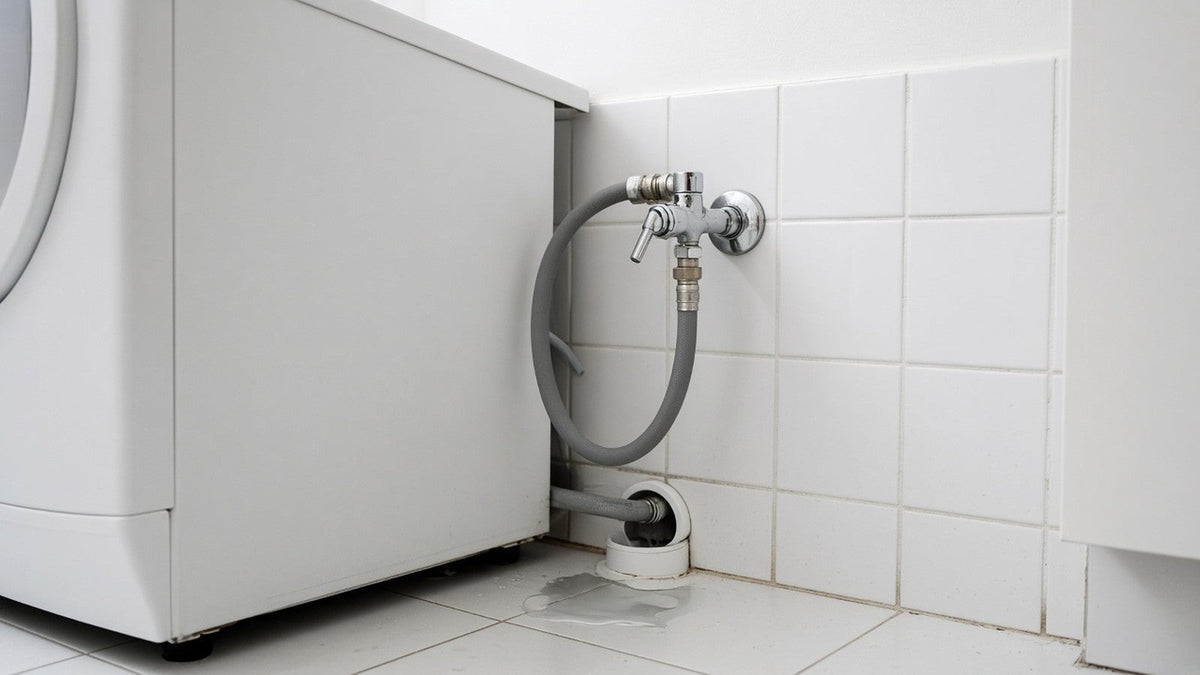
The familiar form is a small sensor on the floor. Contacts or a cable get wet, the device beeps. Newer models add Wi-Fi or a hub and a push notification. Under the dishwasher, beside the washing-machine isolation valve or in a water-heater tray, that is useful. The water reaches the sensor quickly, and you or a neighbour can act.
The limit is location. The alarm knows nothing about a leak two rooms away, in a wall or under a floor until moisture arrives at that exact spot. In an empty house a local beep is little use if nobody hears it and no app message is sent.
A leak alarm under the sink is not enough
A clamp-on Water Grip on the inlet watches all the water entering the home, tracks usage and sends alerts in the app. No plumber needed.
What a whole-house watcher adds
A watcher on the incoming pipe measures how much water enters the home and when. A small, constant flow at night is often a running toilet, a dripping tap or a hidden leak. If use rises over several days without a change in the household, it is worth looking before the bill or the damage grows.
Water Grip clamps onto the pipe. You do not cut the pipe and you do not need a plumber. It fits 15–28 mm copper and 16–32 mm plastic (PEX) or multi-layered (PAL) pipe. In a house, one unit on the inlet is typically enough, because it sees all the water that enters. You can also place one in a kitchen, bathroom or laundry. It measures flow and temperature, alerts you in the app, and has a freeze warning when the pipe it is mounted on reaches 4°C. It runs for up to three years on two AA batteries (non-rechargeable), or continuously from USB-C (5 V, 1 A).
Water Grip does not shut the water off. After the alert, you close the stopcock, or you ask someone else to. For automatic shut-off you need a valve, fitted by a plumber. Quandify’s valve is CubicSecure. Some homes use both.
A flow watcher will not catch every kind of water damage either. Water that is being used as intended — a shower whose waterproofing has failed — can look like normal consumption. That remains a building issue, sometimes helped by a floor sensor in the right place.
A sensible combination
For most houses, a watcher on the inlet is the highest-value first step, because it sees flow you cannot see. One or two classic leak alarms are a useful extra where an overflow gets messy fast, especially under the dishwasher. If the house is often empty, how the alert reaches you matters more than how loud the beep is. If you want the water to stop when nobody is there, plan for a shut-off valve, not only an alarm.
Water Grip ships to the EU, the UK, Norway, Iceland and Switzerland, with free shipping within Sweden.
FAQ
Is a leak alarm the same as a water watcher?
Not always. An alarm often reacts locally when water reaches a sensor. A watcher usually monitors flow or use for the whole home. Some devices, including Water Grip, combine both.
Is one floor sensor enough for a house?
No. It protects the spot where it sits. Pipes in walls, under floors or in other rooms are outside its view.
Do I need a plumber for Water Grip?
No. It clamps onto a compatible pipe and can be fitted in a few minutes. A shut-off valve should be installed by a professional.
Does Water Grip warn about freezing?
Yes. It measures temperature and warns when the pipe at the mounting point reaches 4°C. It does not stop frost by itself; it gives you time to heat the space or shut the water off.
What to check before you buy
Look at the pipe first, not the marketing name. A clamp-on watcher is only useful if it fits the inlet you actually have. Water Grip covers 15–28 mm copper and 16–32 mm plastic or multi-layer pipe; if your main is outside that range, it is not the right device.
Then look at how the alert reaches you. A siren in a utility room is of little use if you work away from home or own a holiday house. An app alert, and a person who can close the stopcock, matters more than the loudest beep in a shop demonstration.
Then be honest about shut-off. If the product does not include a valve, it will not stop the water for you. That is not a flaw in a well-designed watcher. It is a different product. Buying an alarm and expecting a valve leads to disappointment.
Finally, think about what the device cannot see. Failed waterproofing in a shower, rain ingress and some appliance overflows still need ordinary building maintenance and, sometimes, a floor sensor in the right cupboard. A whole-house watcher is a strong base layer, not a substitute for looking after the house.
If you are comparing types in more detail, our guides to a water leak alarm versus a shut-off valve and a whole-house detector versus floor sensors set out the same choice from the other direction.
Add a watcher for the whole house
Water Grip clamps onto the incoming pipe, so you can fit it yourself. Leak alerts and usage tracking live in the app.


Leave a comment
This site is protected by hCaptcha and the hCaptcha Privacy Policy and Terms of Service apply.